What Is the S&P 500 and Why Is It a Benchmark?

The S&P 500, formally known as the Standard & Poor’s 500 Index, is one of the most widely recognised stock market indices in the world. Created in 1957 by S&P Dow Jones Indices, it is composed of 500 of the largest publicly listed companies in the United States. Covering approximately 80% of the total US stock market capitalisation, the index is often regarded as a benchmark for the US economy and stock market performance.
What is the S&P 500?
The S&P 500 is a market capitalisation-weighted index, which means companies with larger market values have a greater impact on the index’s movements. Market capitalisation is calculated by multiplying a company’s share price by its number of outstanding shares. Large-cap technology firms such as Apple, Microsoft, and NVIDIA currently carry the most influence on the index.
This weighting approach ensures the index reflects the performance of major US corporations but can make it sensitive to fluctuations in the largest companies.
Criteria for Inclusion in the S&P 500
To be selected for the S&P 500, a company must meet these requirements:
- A total market capitalisation of at least USD 14 billion (as of 2024).
- Positive net earnings over the most recent four quarters.
- Listing on the New York Stock Exchange (NYSE) or NASDAQ.
- High liquidity and sufficient free-float market capitalisation.
The top 10 companies as of March 2025 include Apple, Microsoft, NVIDIA, Amazon, Meta Platforms, Alphabet, Berkshire Hathaway, Broadcom, and Tesla. Together, these firms account for over 34% of the index weight, highlighting the concentration in technology and communications sectors.
Historical Performance of the S&P 500
The S&P 500 has shown resilience through major crises:
- 2008 Financial Crisis – significant drop following the Lehman Brothers collapse.
- 2020 COVID-19 Pandemic – a rapid decline exceeding 30% in a single month.
- 2022 Inflation & Rate Hikes – a year-long correction triggered by aggressive Federal Reserve policies.
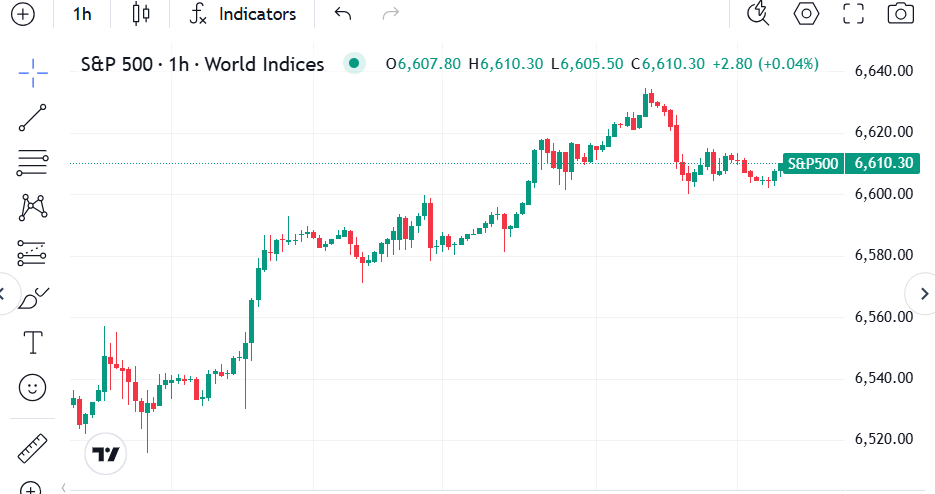
Despite these setbacks, the index has demonstrated long-term growth. From a low of around 720 points in March 2009, it surpassed 6,000 points by late 2024, reflecting strong corporate earnings, technological innovation, and economic recovery.
Why the S&P 500 is a Benchmark
The S&P 500 serves as a benchmark index due to several factors:
- Broad Coverage: Includes 500 major companies across multiple sectors.
- Market Representation: Represents roughly 80% of US stock market capitalisation.
- Investment Reference: Used as a standard for ETFs, index funds, and other financial products.
- Global Influence: Movements in the S&P 500 often guide global market sentiment.
Future Outlook of the S&P 500
Key factors shaping future trends include:
- US Monetary Policy: Potential interest rate cuts may boost liquidity and market growth.
- Technological Innovation: AI, semiconductors, and green energy continue to drive performance.
- Global Risks: Geopolitical tensions and uncertainties in global markets may lead to short-term volatility.
Analysts predict potential highs between 6,500 and 7,000 points by the end of 2025, although short-term fluctuations are expected. Investors should monitor economic indicators, corporate earnings, and policy changes closely.
How to Invest in the S&P 500
While the S&P 500 is an index and not directly tradable, investors can gain exposure through:
- ETFs (Exchange-Traded Funds): Ideal for long-term, passive investment.
- CFDs (Contracts for Difference): Allow long or short trading with leverage for active traders.
- Index Futures & Options: Commonly used for hedging or speculation.
Each investment method carries distinct risks and rewards, and the choice depends on your investment strategy, risk tolerance, and time horizon.
Comparing the S&P 500 with Other US Indices
- Dow Jones Industrial Average (DJIA): Tracks 30 large companies using a price-weighted method.
- Nasdaq Composite Index & Nasdaq 100: Focus on high-tech and IT companies.
- Russell 2000: Tracks US small-cap stocks and serves as a leading indicator for market trends.
The S&P 500 remains the most widely followed index for general US market trends and investment benchmarking.
Conclusion
The S&P 500 is more than just a stock index—it is a reflection of the strength, innovation, and global influence of the US economy. By tracking the performance of 500 major companies, it provides investors with a reliable benchmark for understanding market trends and making informed investment decisions. Its long-term resilience, broad market coverage, and central role in global finance make the S&P 500 an essential tool for traders, portfolio managers, and individual investors alike.
Read more articles