Meta: Company Overview and Strategic Shifts
Meta Platforms, Inc. (formerly Facebook) is headquartered in Menlo Park, California, and remains the world’s largest social networking company. As of 2024, the company employs over ~76,800 people globally. Originally founded in 2004 by Mark Zuckerberg, Eduardo Saverin, Dustin Moskovitz, Andrew McCollum, and Chris Hughes, Facebook began life as a campus pastime with a $15,000 investment from Saverin and caught early traction thanks to Peter Thiel's $500,000 backing—prompting the founders to leave Harvard to focus on growth
In October 2021, the company rebranded as Meta to signal a strategic pivot toward the long-term vision of the metaverse and a growing focus on artificial intelligence (AI)—moving beyond its identity as “just a social media company”. Despite the evolution, Meta’s core platforms—Facebook, Instagram, WhatsApp—continue to lead globally with over 2 billion daily active users and 3 billion monthly users by the end of 2024.
Business Model and Strategic Focus
Meta’s business model remains anchored in digital advertising, which accounted for approximately 97–98% of total revenue in 2024–2025—thanks to its vast user base and AI-driven targeting systems.
However, the company is actively diversifying:
- Reality Labs: Meta’s VR/AR division, which includes Oculus/Quest and Ray-Ban Meta smart glasses, though currently loss-making, embodies its infrastructure venture into the metaverse.
- AI Products & Llama: Launched Meta AI assistant and developed the Llama large language models (latest Llama 4 released April 2025), positioning itself in open-source AI with growing commercial applications.
- Non-advertising revenue: Sales of hardware (e.g., Quest 3, Ray-Ban smart glasses), enterprise services like WhatsApp Business, and AI model APIs are emerging but currently modest contributors.
Regional breakdown of Meta’s advertising revenue (approximate): North America ~38%, Europe ~25%, Asia-Pacific ~24%, Other ~13%—notably excluding China, where its platforms remain blocked.
Product Ecosystem
Meta’s diversified ecosystem revolves around five core products/services:
By far the most widely used social platform, with nearly 25% of the global population using it daily. Its engagement tools (Reactions, Stories, Live, Groups), real-name policy, and AI-feed curation ensure stickiness.
Adopted swiftly by younger audiences since the 2012 acquisition. Powered by AI-driven Reels, influencer commerce, Shopping Tags, and personalized content, driving rapid ad revenue growth.
With 2 billion users across 180+ countries, WhatsApp thrives on encrypted messaging, business APIs, automation, and multi-device support, expanding its footprint especially in Latin America and Southeast Asia.
• Reality Labs
Quest 3 (2023 headset with mixed reality), Ray-Ban Meta glasses, VR/AR software like Horizon Worlds—forming the metaverse engine despite ~US$60 billion in cumulative losses since 2020.
• Threads
A text-based, Instagram-linked platform launched in 2023 with 350 million users by mid-2025. Pursuing interoperability and decentralized protocols via ActivityPub.
Competitive Landscape
Meta navigates a multi-front competitive battlefield:
- Social Platforms: TikTok, Snapchat, YouTube Shorts, and X are eroding attention, particularly among younger users.
- Ad Platforms: Meta and Google command a duopoly in digital ad spending in North America and Europe, while Amazon Ads, TikTok Ads, and Apple Search Ads are rising in specific sectors.
- Messaging: Competitors like Telegram, Signal, WeChat, LINE, and iMessage hold sway in privacy, regional dominance, or ecosystem integration.
- AI Assistants: Meta AI and Llama compete against ChatGPT (OpenAI), Google Gemini, Anthropic Claude, and emerging enterprise AI tools.
Growth Trajectory: Metaverse & AI
Meta is undergoing a dual strategic shift aimed at unlocking its next S-curve:
Metaverse
Proof of concept delivered via Quest VR, Horizon platforms, and gaming IP acquisitions (Beat Saber, Ready At Dawn, etc.) ensures consumer engagement, although Reality Labs remains unprofitable—losing billions as Meta builds infrastructure.
AI Wave
Since 2023, AI has become central—Llama LLMs, AI assistants, new hardware (e.g., smart glasses), and massive capex deployments signal this shift. Meta 2025 expects Q1 revenue of $42.3B (+16% YoY) and Net Income of $16.6B (+35%), with AI-led advertising gains and capex raised to $64–72B.
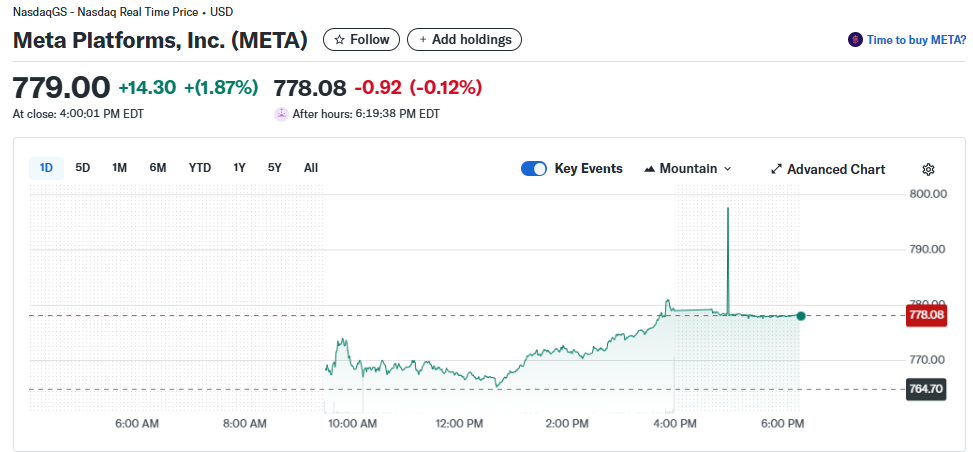
Analysts are optimistic. Q2 stock surged ~11% after earnings, nearing $2 trillion valuation, while capital investments aim to power AI future growth.
Recent Financial Performance & Outlook

Stock trends:
- Strong post-earnings rally, approaching $2T market cap.
- Analysts consensus: Strong Buy, target ~ $816–$880.
Regulatory and Innovation Challenges
- Facing an ongoing FTC antitrust lawsuit over Instagram and WhatsApp acquisitions. Case proceeding since 2020.
- United in regulatory pressure in Europe over ad model and user experience under the DMA.
- Policy controversies, including content moderation shifts in early 2025, have drawn criticism for relaxed hate speech rules and internal dissent.
On the innovation front, Meta launched Meta Superintelligence Labs in mid-2025 to accelerate AI model development beyond Llama, marking commitment to lead in AGI.
Conclusion
Meta’s journey reflects a bold reinvention: from a social media ad platform to a diversified, AI and metaverse-oriented tech leader. With over 3.4 billion daily users, robust ad revenues, and aggressive investments in AI and hardware, Meta is designing its next growth trajectory. While Reality Labs continues to drain capital, AI is catalysing transformation across its ecosystem. For investors and tech enthusiasts, Meta offers a unique blend of scale, ambition, and innovation—and remains essential to understand as a driver of digital interaction and virtual economies.
Read more articles