ASX 200 (AU200) Index: Australia's Premier Stock Market Benchmark

The ASX 200 (AU200) Index, officially known as the S&P/ASX 200 Index, serves as Australia's premier benchmark for the equity market. Established in 2000 by S&P Dow Jones Indices, it includes the 200 largest companies listed on the Australian Securities Exchange (ASX) by float-adjusted market capitalization. Collectively, these companies represent approximately 80% of the Australian equity market, making the index a vital tool for investors seeking exposure to the nation's economic landscape.
Composition and Sector Breakdown
The ASX 200 Index encompasses a diverse range of sectors, reflecting the multifaceted nature of the Australian economy. As of the latest data, the sector allocations are as follows:
- Financials: 34.25%
- Materials: 19.24%
- Healthcare: 8.14%
- Consumer Discretionary: 8.02%
- Industrials: 7.34%
- Real Estate: 6.90%
- Communication Services: 3.91%
- Energy: 3.87%
- Consumer Staples: 3.55%
- Information Technology: 3.34%
- Utilities: 1.44%
This distribution underscores the dominance of the financial and materials sectors in the Australian market, with significant contributions from healthcare, consumer sectors, and industrials.
Key Features of the ASX 200 Index
- Calculation Method: Market capitalization weighted and float-adjusted
- Founding Date: March 31, 2000
- Number of Constituent Stocks: 200
- Representative Constituents: Commonwealth Bank of Australia, CSL Limited, BHP Group Ltd, Westpac Banking Corporation, National Australia Bank Ltd
These features ensure that the index accurately reflects the performance of the largest and most liquid companies on the ASX.
Investment Significance
The ASX 200 Index is widely regarded as the benchmark for Australian equity performance. It serves as a foundational tool for institutional investors, fund managers, and individual investors seeking to gauge the health of the Australian economy. The index's composition allows for diversified exposure across various sectors, making it a preferred choice for those looking to invest in Australia's top-performing companies.
How to Invest in the ASX 200 Index
Investors can gain exposure to the ASX 200 Index through several financial instruments:
- Exchange-Traded Funds (ETFs): ETFs like the SPDR S&P/ASX 200 Fund (STW) and iShares Core S&P/ASX 200 ETF (IOZ) track the performance of the index, allowing investors to buy shares that represent a basket of the 200 constituent companies.
- Futures Contracts: Futures contracts on the ASX 200 Index are available on the Australian Securities Exchange, enabling investors to speculate on the index's future performance.
- Managed Funds: Some managed funds invest in the constituent companies of the ASX 200 Index, providing investors with diversified exposure.
Each investment vehicle has its own set of risks and benefits, and investors should consider their individual financial goals and risk tolerance before investing.
Recent Market Trends
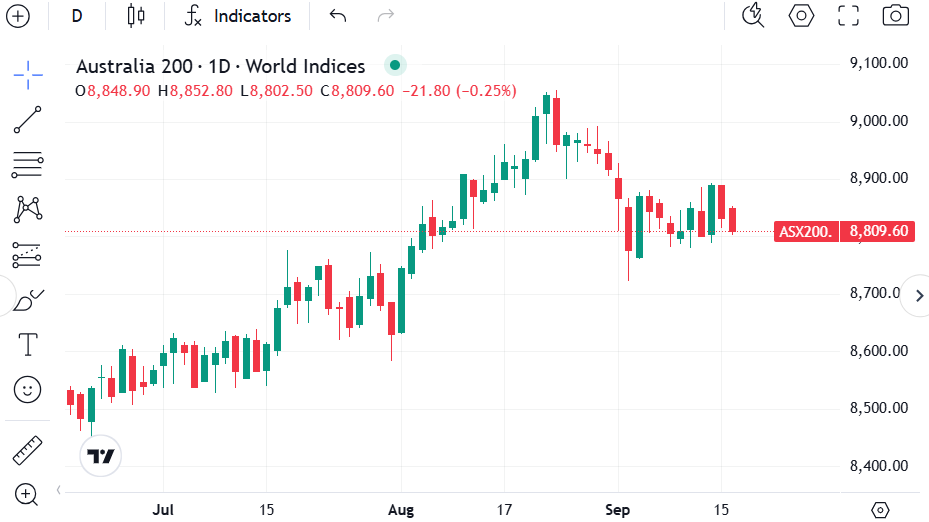
The S&P/ASX 200 Index has demonstrated notable resilience in 2025, recording a gain of approximately 8.65%. This positive performance persists despite challenges such as three consecutive years of earnings contraction. Over the past 12 months, the index has delivered a return of about 9.44%, reflecting an overall upward trajectory in the market amid periods of volatility.
Recent Market Performance
As of September 2, 2025, the ASX 200 Index reached a record high of 9,054.50 points before experiencing a slight pullback to 8,891.20 points. Despite this dip, the index has delivered a 15% return over the past 12 months, even amidst three years of earnings contraction. Notably, August's reporting season saw earnings per share forecasts downgraded by 1.3 percentage points, yet the market rose 3% during the month. Analysts caution that the rally isn't earnings-driven, with FY26 earnings growth forecasts falling sharply to 3.4%.
Dividend Outlook
The ASX dividend outlook appears uncertain despite a 2.6% rise in the market during the earnings season. While some companies like Wesfarmers, Qantas, JB Hi-Fi, and the Australian Foundation Investment Company issued special dividends, overall payouts are expected to be slightly down compared to last year. The ASX 200’s forward dividend yield is about 3.3%, below the historical average of 4.5%, due to falling mining profits and rising share prices. Analysts highlighted strong performances by some tech and industrial companies, but flagged challenges for banks and resource stocks, whose share price growth has outpaced profits, squeezing yields.
Sector Rotation Trends
There are signs suggesting a possible sector rotation in 2025, possibly driven by increased acquisitions as miners utilize their cash to enhance market share. With Chinese monetary policy stimulus and the prospect of rate cuts, Australian miners could be well-positioned for a strong year ahead. Conversely, banks may be perceived as overvalued, while miners may be seen as undervalued.
Growth Stocks to Watch
Several growth stocks have shown exceptional returns between May and August 2025. Notable mentions include:
- NEXTDC Ltd (ASX: NXT)
- Pro Medicus Ltd (ASX: PME)
- WiseTech Global Limited (ASX: WTC)
These companies have delivered returns ranging from 10.63% to 85.37% over the three-month period, attracting attention from traders and investors alike.
Conclusion
The ASX 200 (AU200) Index remains a pivotal benchmark for Australia's equity market, reflecting the performance of the top 200 companies listed on the ASX. While recent market trends indicate strong performance, investors should remain cognizant of potential risks, including stretched valuations and sector-specific challenges. Staying informed about sector rotations and emerging growth stocks can provide valuable insights for investment strategies.
Read more articles